Sunday, October 11, 2015

Ronda Rousey: "My Fight Your Fight"

Ronda Rousey's "My Fight Your Fight" hit the bookshelves with impeccable timing, just as her fame and popularity attained new heights and reached audiences well beyond the usual UFC/MMA crowd.  Like myself, to be sure.  The stories of Rousey's bouts ending in mere seconds (12 seconds?!!?! How is that even possible?) reached the mainstream, and her combination of good looks, toughness, athleticism, and entertainment marketing converged during her book tour.  I happened upon her book tour scheduled stop in Kansas City just a few days prior to the event, and decided to attend and check out the Rousey-pandemonium first hand.  So, my two sons and I went to see and meet Ronda in person.


The book signing was crowded and as raucous as a book-signing can be, though nothing got out of control, thanks to police presence as well as Rousey's entourage.  Quickly the "no pictures from the stage" rule dissolved away, through the crowd still moved through the book queue quickly.  Ronda shook hands, posed, and spoke to each person coming through the line.  It was a great event.  Capping the event was Ronda coming down from the stage to greet a wheelchair-bound special needs fan.  She spent a few minutes talking to the the young man, who was ecstatic to be able to meet and share some time with the Champ.

Enough about the booksigning - how about the book?  "My Fight Your Fight" is a very good sports memoir/autobiography.  Ms. Rousey describes her youth, including the tragic death-by-suicide of her fathter, and her subsequent rise through the USA Judo ranks, culminating in two Olympic games.  Her story continues on to her few amateur MMA bouts, and then her turning pro in the UFC, through her current status as the undisputed most popular athlete in the ranks.


As a framework, each chapter begins with a few paragraphs about achievement, hard work, no-pain-no-gain, stuggles-bearing-success, and the like.  This framework does provide an effective motivational thread through the book, but overall does not add significant interest.  It's OK, but that's it.  

Ronda's insight and story about her years in the world of Olympic-caliber judo, though, are fascinating.  The struggles with coaching, the terrifying (to me) methods of weight-cutting, and the minimal support from the governing association are eye-opening and superbly interesting parts of this sports auto-bio.  The reader gets a close sense of what it takes in terms of day-to-day and also months-long efforts to reach the peak of the sport.

What also works in "My Fight Your Fight" are Ronda's descriptions of her bouts and opponents.  She gives us detailed insights into the athletes that she has fought, and move-by-move accounts of the fights.  I found myself going to Youtube to watch the fights after reading her detailed descriptions, which always include her recollections of her thoughts during the matches.  These chapters were the best of the book.

Der Bingle recommends "My Fight Your Fight".

Sunday, October 4, 2015

"House of Leaves" by Mark Z. Danielewski

"House of Leaves" by Mark Z. Danielewski was originally published in 2000, and it was at least a couple years later that I read about it, and purchased my own copy after being very intrigued about the reviews and descriptions of the book.  It's been sitting on my bookshelf ever since, waiting for the right time to open it and begin the daunting project of reading.  At over 700 pages, it would seem to be a novel that would take quite a bit of time to finish.  And, flipping through the pages and seeing its structure adds the 'project' qualifier to the reading experience.  Every October I try to dive into books and stories of horror and the macabre, being with the spirit of the Halloween season, and so this year with October approaching, I decided to start "House of Leaves".  If I didn't like it, I'd concede and not make the presumably weeks-long investment in finishing, having given it my best shot before moving on.

One week and 709 pages later, I have finished "House of Leaves".


This novel was intriguing, scary, gripping, tedious, challenging, and a total trip of a reading experience.  It's unlike any other book I've ever read, and it will be for you as well, should you decide to take it on.

"House of Leaves" is about a house that is bigger on the inside than the outside.  (Not really like a Tardis, no...).  But not really.  It's about a movie that may or may not exist about a house that is bigger on the inside than the outside.  But, it's really about a blind man's excruciatingly-detailed analysis of the movie that may or may not exist, written as he lived inside a barricaded room, because of the movie that may or may not exist.  Er, not really.  It's about the narrator, Johnny Truant, finding the blind man's (Zampano is his name) manuscript about the movie about the house, and his descent into madness while reading and annotating Zampano's pages.  Sort of.  Ultimately it's about all of these things, and perhaps more, or perhaps less.

The book is recursive to a degree.  There are John Barth-ian elements of a book within a book, or maybe a book that is self-aware.  The book itself draws the reader in to the plot in many creative and very satisfying ways.  You will feel claustrophobic, you will experience an escape along with the characters, you will feel the influence of the house and all of its terrifying peculiarities.

Whew.

The core of the book, the story of the house and its endlessness (frequently compared to the classic labyrinth), was the most satisfying element of the novel.  An extra quarter-inch inside the house revealed concurrently with a suddenly discovered new room gets your attention.  A hallway that shouldn't exist but takes 5 1/2 minutes to traverse grabs you.  A door leading to an endless(?) spiral staircase sucks you in for good.  This central story is as good and scary as any other classic tale of horror.  It's what kept me going.

Less interesting to me was Johnny Truant's story, woven in through extended footnotes until several chapters at the end.  Although, I'm sure that Johnny's story was the actual central theme, it still didn't hold my attention as much, and I found myself working through his notes just to get back to the story of the house.

Every reader of "House of Leaves" is likely to have a different experience.  It's a masterwork of vision by the author, and makes the reader a true participant in the story as no other.

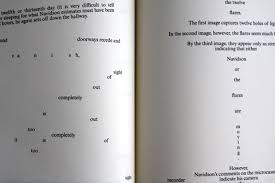
There are many different editions of "House of Leaves".  Fonts, color, and printing abnormalities are essential to the story, as you'll see in the following pictures.  The first two are representative of my edition.  The third is from a more deluxe edition, with additional colors and crazy printing.


"House of Leaves" is an adventure.  Its 709 pages went by much faster than I ever imagined they could.  If you're up for a challenge, check it out.


Monday, September 7, 2015

Rapid Review: "Station Eleven" by Emily St. John Mandel

After three previously published crime/mystery novels, author Emily St. John Mandel branched into futurist/sci-fi/post-apocalyptic genre with "Station Eleven", her breakout novel.  "Station Eleven" made the short list for numerous awards, winning several along the way.

Although the story of Earth post-decimation by killer virus has been visited many times by many authors, few have tackled it as well as Ms, Mandel.  In her version, Earth's population has been all but eradicated by the Georgian Flu, leaving only a few survivors who, via cautious wandering and/or quarantine areas have clustered together.  No explanation is given for the new virus, nor is any needed.  Dwelling too much on the science of virology, immunity, and cures can take away from the core of the plot.  Kudos to Ms Mandel for avoiding the unnecessary.


"Station Eleven" threads together multiple stories and timelines, from the origination of the outbreak and the central characters' introductions, to the future where a band of artists travel the land keeping the spirit of humanity alive through productions of Shakespeare's plays.  Another group of survivors has stayed in a quarantined airport terminal for years, hanging on to their sense of being and community be any means possible.

"Station Eleven" deservedly earned all the praise it has received.  It is a refreshing take on the post-killer-virus world, with true heart and soul at its core.  Interestingly, even though "Station Eleven" has been a best seller and multiple award winner, it wasn't until Spring of 2015 during her book tour that Ms. Mandel was able to quit her day job as an executive administrator and devote herself completely to writing.  She announced this during her stop in Kansas City - no more making travel arrangements for her company while she was on book tour.

For a unique and fascinating divergence into a new genre, try "Station Eleven".


Sunday, September 6, 2015

"Tenth of December" by George Sauders

I was not familiar with George Saunders until reading "Gumption" by Nick Offerman (previously reviewed in this blog).  Mr. Offerman described George Saunders as one of America's best writers, and perhaps the funniest author of our literary age.  So, I had to give George Saunders a try.  "Tenth of December", Saunders' most recent collection of stories, was my initiation.

From the first few paragraphs (actually, it was the second) of the first story "Victory Lap", I was hooked.  Funny?  Absolutely.  Unpredictable?  Assuredly.  Creative?  Boundlessly.  Every story in this collection has moments of complete hilarity - you find yourself chuckling at a phrase or a thought from one of Saunders' characters.


Somewhere around the third or fourth story I realized that the stories seemed kin in spirit to David Sedaris' work.  I had not yet discovered the interview of George Saunders by David Sedaris to finish out the book.  Obviously others have recognized them both as twin rulers of American Satire.

Highlights?  Heck, every story in the book is a highlight.  "Sticks" totally cracked me up, especially one sentence in particular containing the word "glee" (I don't dare quote the sentence in this review - it would ruin the experience for the reader).  "Escape from Spiderhead" was a bizarre dive into pharma-tech that bordered on sci-fi.  "The Semplica Girl Diaries" was a long 'what-the-heck?' journey through the plot as told be a wanna-be journaling dad.

"Tenth of December" is an outstanding collection of stories that entertains from the first through the last.

"Revival" by Stephen King

I've been reading Stephen King since I was 18 - that would be since 1982, if anyone is counting.  To me,  Mr. King's work has gone through phases over the years.  I loved his early work - "The Dead Zone", "The Shining", "Carrie", "Firestarter", and of course "The Stand" (one of very few books I've read twice).  Then came "Cujo", "Christine", and others from that timeframe that didn't seem to be of the same quality.  Was he trying too hard?  Stretching thin ideas into 400+ pages?   Some of the work of the next period were, for me, unmemorable ("The Talisman", co-authored with Peter Straub) or unfinishable ("The Tommyknockers").

Over the years I kept reading Stephen King's work here and there.  I always enjoyed his story collections.  Several books were great reads for 80% of the book, followed by a flat ending ("It", "The Girl Who Loved Tom Gordon", "Needful Things").  Some works were good.  Many are still on my shelf still to be read.


With "Doctor Sleep" in 2014, Stephen King returned to top form.  Revisiting the story started decades earlier in "The Shining", "Doctor Sleep" was tight, tense, exciting, and a perfect continuation of the original.  It was hard to put down each night until I finished it.  A great return to form.  But I'm not here to talk about "Doctor Sleep".

"Revival", also released in 2014, is, in my opinion, one of Mr. King's best works, a top 10 selection alongside "The Stand" and "Salem's Lot".   "Revival" spans many years in the life of Jamie Morton and his relationship with enigmatic preacher Charles Jacobs, who conducts bizarre experiments with electricity.  Jacobs' and Morton's paths cross many times through the years, from the earliest when Jacobs comes to town as a local church minister, through a renewal encounter on the carnival circuit, to Jacobs' later years as a television evangelist.

There are two points I want to make about "Revival".  First, the plot is exceptional.  It is fast-paced, it is engaging, it is full of points that make you think you know what is coming next, only to be taken a different direction.  It's a superb, great story.  Second - this is the scariest plot climax King has ever written.  No details from this reviewer - no spoilers - but the unveiling of the secret behind Jacobs' electricity is the most terrifying imagery ever to come from Mr. King.  It ranks alongside Bram Stoker's description of Count Dracula scaling down the side of the castle tower,

"Revival" is one of King's, heck, Top 5, maybe Top 3.  Get it, read it, get scared.

Sunday, August 30, 2015

Review: "The Bone Clocks" by David Mitchell

One the the joys of reading a fine, layered, complex book like "The Bone Clocks" by David Mitchell is the experience of the revealing of the plot, discovering and understanding the connections that the author has skillfully created, culminating in the finale and resolution.  The resolution may be satisfying, tragic, or sometimes even left to the imagination of the reader ala T.C. Boyle's "The Tortilla Curtain", but the author in complete harmony with the story creates a perfect resolution for the reader after a sometimes long literary expedition.

One of the difficulties of reviewing a book with a complex plot filled with moments of enlightenment along the, in the case of "The Bone Clocks", 624-page journey, is not revealing plot points that will harm the experience for other readers.  In other words, no spoilers.  But, challenge accepted, so here goes.

"The Bone Clocks" is the story of the life of Holly Sykes, a teenaged runaway following a breakup with her boyfriend.  Holly hears voices and has brief encounters with who she calls "The Radio People", and experiences time losses - she suddenly realizes that she has completely lost hours of her life with not a shred of recollection as to what happened.  During the several days where she has run away, her little brother Jacko, who is smart and wise beyond his years, disappears without a trace.  Foul play is suspected, the assumed crime remains unsolved, but Jacko's disappearance continues to haunt Holly.

Unexplainable experiences follow Holly as she grows - visits from the mysterious Immaculee Constantin, a psychic experience involving Holly's daughter Aoife, and practically Whovian time anomalies.  Holly's place in an extra-natural world becomes clear as the story progresses toward a bleak but superbly satisfying conclusion.


Ultimately, "The Bone Clocks" is superb.  The tale is long out of necessity.  There are times during the diligently-paced first half of the book where you are wondering when the story's pace will quicken.  At the end, you realize that everything, every element, is deliberate and important.  If it wasn't over 600 pages I would read it again to pick up on intricacies that I missed the first time through.

The final section of the book, titled "Sheep's Head", referring to Holly Sykes' town of residence, in addition to a perfect closure to Holly's story, doubles as a powerful message about our Earth and our lack of stewardship, our dependence on technology, and a chilling too-possible future state.

Author David Mitchell, of "Cloud Atlas" fame and also translator of the amazing "The Reason I Jump", has delivered a gripping, complex novel blending the real with the paranormal for those who are ready for a challenging and satisfying reading experience.


Wednesday, August 5, 2015

Rapid Review: "Prince Lestat" by Anne Rice

"Prince Lestat" is the latest in Anne Rice's acclaimed Vampire Chronicles series which began with "Interview with the Vampire" so many years ago.  "Prince Lestat" returns to the story of our blood-drinking hero Lestat de Lioncourt as he, the elders of the world's vampires, and some newer blood fend off a threat called "The Voice" (which has nothing to do with Adam Levine or Blake Shelton).  Nearly every blood-drinker from every previous story in the series appears in "Prince Lestat" as well as some new, modern, tech-savvy characters.


"Prince Lestat" is for the fans of the series (of which I am one), and it works well. The storyline around "The Voice" and the revelation about its identity move fast through multiple plot threads, culminating in an exciting climax and denouement.   I loved reacquainting myself with some old vampiric friends, and meeting some new additions to the cast of the undead.

A couple of the sub-threads didn't work well for me, and one in particular seemed to have some timeline issues that didn't jive.  But this is a minor quibble.  If you're a fan of Ms. Rice and the Vampire Chronicles, you'll like "Prince Lestat".  I only hope that Lestat comes to visit us on a few more occasions before he goes into the Earth for the last time.

A quick note about Ms. Rice:  I got to meet her briefly at a book signing a few years ago, and I had my (then) 4 year old daughter with me.  Anne Rice was about the nicest author I've ever met!  She spent several minutes talking to my daughter and asking her all about the toy stuffed lion she was carrying with her.  It was great!

"Prince Lestat" on Amazon